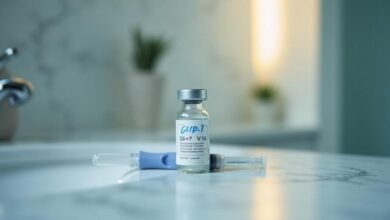
NAD+ and NMN are sold as supplements and, in clinical settings, prepared as compounded medications. The human evidence that either one slows aging is still limited. This piece is meant to help sort through the options, not to sell anything.
Anyone who has browsed a “longevity membership” lately has probably noticed how similar they all look. A short online intake, a monthly plan, a box that arrives on schedule, sometimes a coaching call thrown in. The pitches are polished and the real differences sit underneath, easy to miss.
Here’s the short version, worth knowing before anything else: with NAD+ and NMN, the thing actually worth paying for is oversight and sourcing, not the molecule. The molecule itself is available in a dozen places. What’s harder to find, and what a good program should provide, is a licensed clinician deciding whether it makes sense for a given person, and a real pharmacy preparing it properly. Holding onto that idea makes the rest of this much simpler.
Three very different things go by the name “program”
The word “program” gets stretched to cover a lot of ground.
At one end sit supplement subscriptions: sign up, capsules arrive monthly, no medical relationship involved. That’s a product subscription dressed up in program language. In the middle are supervised telehealth programs, where a licensed clinician reviews someone’s history, decides whether a compound like NAD+ is appropriate, and a prescription routes to a licensed pharmacy. The monthly fee there covers oversight, dispensing, and ideally some follow-up. At the far end are research-chemical sites, which simply sell a vial marked “for research use only.” No clinician, no plan, no one accountable if something goes wrong.
Most people picture the middle category when they hear “NAD+ program,” and that’s the only version where the monthly fee buys something a gray-market seller cannot offer: judgment and accountable sourcing.
What the evidence actually shows
Before spending money, it helps to know what’s being paid for, because no program changes the underlying science.
NAD+ really does decline with age, measured directly in human tissue in a 2012 study spanning newborns to 77-year-olds [P5]. Precursors appear to do something: a 2018 placebo-controlled crossover trial of nicotinamide riboside, a close cousin of NMN, was well tolerated and raised NAD+ in healthy middle-aged and older adults [P3]. NMN has a couple of small, real trials behind it. The strongest is a 2021 Science study in which 250 mg a day for 10 weeks improved muscle insulin sensitivity in 25 prediabetic postmenopausal women [P1]. A separate 2021 trial in amateur runners found some aerobic benefits, though VO2max didn’t budge [P2].
None of that proves that raising NAD+ slows aging. A 2026 PRISMA-guided systematic review found no eligible outcomes trials testing IV or IM NAD+ for anti-aging or wellness purposes, while confirming that oral precursors reliably raise NAD-related biomarkers, with human outcomes remaining mixed [P6]. A foundational review of the biology puts it plainly: whether restoring NAD+ in aging humans is safe over the long run and actually beneficial is still unknown [P4]. Signing up for any of this means signing up for a hypothesis, which is fine, as long as the program is honest about it. One promising reversed aging on a monthly plan is promising more certainty than exists.
Three things a fee should actually buy
It helps to think of a supervised program’s price as covering three separate purchases, not one.
The first is judgment: a licensed clinician looking at someone’s history and deciding whether a compound is appropriate at all. The second is accountability in sourcing: a licensed pharmacy, following recognized compounding standards, actually preparing what gets shipped. The third is honesty: a program that frames NAD+ and NMN as studied compounds with real limits, not as an anti-aging guarantee.
Any program worth its monthly fee should be able to point to all three. A program offering only one or two of them, usually just the box, isn’t really selling what it implies.
Red flags that should end the conversation
A few signs mean it’s time to walk away:
- No real clinician evaluation before an injectable ships. A quiz that approves everyone isn’t oversight.
- “FDA-approved” used as a selling point. Neither NAD+ nor NMN is an FDA-approved drug for longevity, and any program implying otherwise is misleading.
- Promises of reversed aging or guaranteed results. The evidence doesn’t support them [P6][P4].
- A self-published certificate of analysis standing in for a licensed pharmacy.
- A hard push toward an expensive IV plan, with no honest mention that IV NAD+ has the thinnest controlled human-benefit evidence of the bunch [P6].
- “Research use only” printed anywhere on the product. That’s not a program. It’s a research-chemical sale, with no oversight attached.
What the supervised path looks like in practice
FormBlends is a useful example of the supervised model done properly. It’s a supervised telehealth and compounding provider, not a supplement subscription and not a research-chemical seller. On its public materials, NAD+ sits among its longevity compounds, described in studied terms (“studied for cellular energy and metabolic support”) rather than as a cure, with NMN in the same supervised, oral category. The program runs through a clinician: FormBlends states that all compounded medications require a licensed physician consultation and prescription, and that they’re prepared by licensed 503A compounding pharmacies following USP <797> and <800> standards.
Set that against the three purchases above and it lines up: real clinical review, accountable pharmacy sourcing, and language that doesn’t overpromise. What this kind of program adds isn’t regulatory approval, since none exists here yet. It’s the oversight and the honesty, neither of which a research-chemical subscription can offer.
One small habit makes a supervised program more useful, particularly given how uncertain the benefits still are: keep records. Logging dose, energy, and any symptoms over time, for instance through the FormBlends tracker app, turns “I think it’s working” into an actual pattern a clinician can look at during a check-in. The app is simply a logging tool, not a prescription pad and not a checkout page, but it’s one of the more honest signals available while the science catches up.
FormBlends isn’t the only provider in this tier. HealthRX.com (healthrx.com) runs on the same basic model, clinician oversight first, a prescription required, dispensing through licensed pharmacy channels, with the same honest caveat that these are compounded, not FDA-approved, products. Choosing between the two usually comes down to practical questions: which one is licensed in your state, which compounds each supports, and how the intake process actually feels.
What about the cheaper options?
A lawfully sold NMN supplement subscription can be a reasonable, low-stakes choice for someone who only wants oral NMN and picks a brand that names a third-party lab and tests every batch. Just go in knowing it’s a product subscription, not medical oversight.
Research-chemical sites aren’t programs at all, though they’ll turn up in any search. Worth naming plainly, with the reminder that none of them offers a clinician, a dispensing pharmacy, or follow-up, and their order below reflects general visibility, not verified quality, since purity claims here can’t really be checked:
- Biotech Peptides runs a research-only catalog labeled for research use, no oversight, no plan.
- Swiss Chems sells NAD+ within a broad research catalog that also includes SARMs, with self-issued certificates only.
- Sports Technology Labs offers research compounds alongside SARMs, none of it approved for human use.
- Amino Asylum leans on low prices, which is precisely the wrong thing to prioritize with an injectable.
- Limitless Life markets a research-compound catalog in longevity-adjacent language that sounds confident but can’t be verified.
The “research use only” label across all of them is the tell. It’s the legal mechanism that lets a product ship without drug regulation, and it means the oversight a real program provides simply isn’t there.
A few questions, answered plainly
What’s the actual difference between NAD+ and NMN, and does it matter which one gets prescribed? NAD+ is the active coenzyme cells use directly. NMN is a precursor the body converts into NAD+. The distinction matters because the two compounds behave differently: absorption, stability, and regulatory status all differ. NAD+ given intravenously skips the conversion step, but taken orally it’s poorly absorbed. Oral NMN has shown reasonable bioavailability in early human studies, though long-term outcome data remain thin.
Is NMN a legal supplement, or does it need a prescription? NMN’s legal status has been genuinely tangled. The FDA issued a warning in 2022 that NMN couldn’t be lawfully marketed as a dietary supplement, on the grounds that it had already been investigated as a drug. That position has been contested since, with some retailers continuing to sell it while the question sat unresolved. A prescription route through a licensed compounding pharmacy places someone on clearer regulatory ground than buying from a retailer operating in that gray area.
How can someone tell if a telehealth program is monitoring NAD+ levels or just shipping a subscription box? Ask directly whether baseline and follow-up NAD+ blood testing is part of the plan, and who actually reviews the results. A genuine program runs labs before dosing and rechecks them on a defined schedule. If a program can’t name the specific test panel, the lab used, or the clinician reading the results, it’s functioning more like a subscription box than a medical service, and conversion from NMN to NAD+ varies enough between people that this monitoring matters.
Can NMN or NAD+ interact with medications someone already takes? Possibly, yes. NAD+ precursors touch pathways tied to sirtuins and PARPs, DNA repair enzymes, and there’s real theoretical concern about interactions with certain chemotherapy agents and methylation-affecting medications. Human evidence here is still thin, which is exactly why this isn’t something to self-assess. A telehealth provider should review a full medication list before recommending either compound, not after someone has already signed up.
References
Sources: NMN and muscle insulin sensitivity in prediabetic women, Science 2021, https://pubmed.ncbi.nlm.nih.gov/33888596/ [P1]. NMN and aerobic capacity in amateur runners, VO2max unchanged, J Int Soc Sports Nutr 2021, https://pubmed.ncbi.nlm.nih.gov/34238308/ [P2]. Nicotinamide riboside well tolerated, elevates NAD+ in middle-aged and older adults, Nat Commun 2018, [P3]. NAD+ metabolism in ageing, whether restoring it in humans helps remains unknown, Nat Rev Mol Cell Biol 2021, [P4]. Age-associated NAD+ decline in human tissue, PLoS One 2012, [P5]. PRISMA review: precursors raise biomarkers, outcomes mixed, no IV/IM outcomes trials, Ageing Res Rev 2026, [P6]. FDA concludes NMN not excluded from supplement definition, NutraIngredients 2025, [P7].