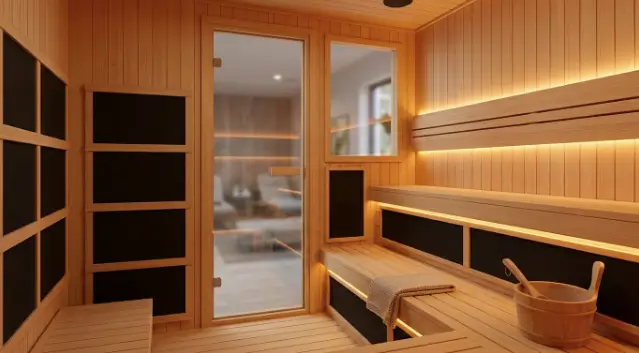
For two people committing to daily use, the best setup is a two-person cabin with side-by-side bench seating, full panel coverage across both seats, and 16 to 20 square feet of interior space, paired with a dedicated 120-volt circuit that can handle a session every day without strain. Daily use changes the calculus from an occasional-use cabin: panel durability, even heat distribution, and low ongoing electricity cost matter more than they would for a once-a-week setup.
Why Bench Layout Matters More for Daily Users
Cabins with facing benches look appealing in photos, but for two people using the sauna every day, side-by-side seating along one wall generally works better in practice. It puts both users at a similar distance from the same panel bank, so heat exposure stays consistent session after session, rather than one person facing panels directly and the other getting indirect exposure from the side. It also means less negotiating over who sits where, which sounds trivial until you’re doing it 365 days a year. Look for a two-person model with at least 16 square feet of interior floor space, since anything tighter starts to feel cramped once you’re both in there daily rather than occasionally.
Do the Panels Actually Hold Up to Daily Use?
This is the question people underestimate most. Quality carbon or ceramic infrared panels from established manufacturers are typically rated for tens of thousands of hours of operating life, which at a 30 to 45 minute daily session works out to many years of regular use before any meaningful degradation. The gap shows up with cheaper panels, where thinner heating elements and lower-grade wiring can start losing output or developing hot spots well before that lifespan is reached. If daily use is the plan from day one, it’s worth paying attention to panel wattage density and manufacturer warranty length rather than just the sticker price, since a warranty of 5 years or more on the panels themselves is a reasonable signal the manufacturer expects the unit to handle frequent use.
What Does the Evidence Say About Using a Sauna Every Day?
The most-cited research here comes from long-term Finnish cohort studies, including the review published in Mayo Clinic Proceedings, which found that people who used a sauna more frequently per week had lower rates of cardiovascular events and all-cause mortality compared to those who used one less often. A related systematic review in Evidence-Based Complementary and Alternative Medicine reached similar conclusions about regular sauna bathing and cardiovascular markers. It’s important to be precise about what this shows: it’s an association found in traditional Finnish-style sauna bathing, not infrared specifically, and it doesn’t prove that frequency alone causes the benefit rather than reflecting healthier habits generally among frequent sauna users. Still, the direction of that evidence is consistent enough across multiple studies that daily or near-daily use, within reason and without ignoring how your body responds, is a defensible habit rather than something you’re overdoing.
What Does Daily Use Actually Cost?
At around 15 to 30 cents in electricity per session, one session a day adds roughly $5 to $10 a month depending on your local utility rate and how long each session runs. That’s a modest ongoing cost, especially compared to a gym membership or a recovery-focused spa visit, and it’s one of the clearer financial arguments for infrared over a higher-draw traditional electric heater if daily use is genuinely the plan. Upfront, a solid two-person cabin built for frequent use typically lands in the $2,500 to $4,500 range, and it’s worth comparing current models and their per-panel warranty terms before deciding, since pricing and included features shift regularly across sellers. You can view current pricing for a range of two-person configurations to see how features line up against that budget.
What Two-Person Daily Users Often Overlook
Ventilation gets skipped more than it should. A cabin used once a week can air out on its own between sessions, but a daily-use cabin needs a deliberate airing routine, cracking the door or vent for 10 to 15 minutes after each session, to keep humidity from lingering and to extend the interior wood’s life. Towels or a removable bench cover also matter more for daily use, since skin oils and sweat accumulate faster with frequent sessions, and a cabin that’s easy to wipe down keeps maintenance from becoming a chore either person skips.
It’s also worth agreeing on a shared schedule early, whether that’s both people in together each evening or staggered solo sessions, since inconsistent use is the most common reason a “daily sauna” plan quietly turns into a twice-a-month one within a few months of ownership.
See also: NAD+ or NMN Telehealth Program? A Calm Guide to Choosing Well
What Placement Works Best for a Daily-Use Cabin?
Location matters more once daily use is the plan. A cabin tucked at the far end of a backyard sounds fine in spring, but on a rainy or freezing evening six months later, that extra walk is exactly the kind of small friction that quietly ends a daily habit. Placing the cabin somewhere close to the house, a covered porch, an attached garage, or even a finished basement corner, removes that barrier and makes it realistic to actually use every day rather than only on weekends when you’re already outside. If indoor placement isn’t an option, a short, covered, well-lit path between the door and the cabin makes a bigger difference to consistency than people expect before they’ve lived with the routine for a few months.
Temperature control also matters more for two people with potentially different preferences using the cabin daily. Look for a model with independent or at least clearly labeled temperature settings, so you’re not negotiating the thermostat every single evening. Small friction points like that add up fast when a routine is meant to happen 365 days a year instead of occasionally, and they’re often the quiet reason a well-intentioned daily habit fades after the first few months.
Frequently Asked Questions
What size infrared sauna is best for two people using it daily?
A cabin with roughly 16 to 20 square feet and side-by-side bench seating tends to hold up better for daily use, giving both users consistent panel exposure.
Is daily infrared sauna use hard on the panels?
Quality panels are typically rated for tens of thousands of hours, so daily 30 to 45 minute sessions are within normal wear, though cheaper panels may degrade faster.
Is there research supporting frequent sauna use for health benefits?
Long-term cohort research links more frequent traditional sauna use to lower cardiovascular event rates, though this is an association, not proof that frequency alone causes it.
How much does daily infrared sauna use cost per month in electricity?
At 15 to 30 cents per session, daily use typically adds $5 to $10 a month, depending on local rates and session length.
Do two people need separate infrared sauna panels to both benefit?
No. A properly sized two-person cabin distributes panel coverage across the full bench area for comparable exposure to both occupants.
References
- “Cardiovascular and Other Health Benefits of Sauna Bathing: A Review of the Evidence.” Mayo Clinic Proceedings, 2018. https://pubmed.ncbi.nlm.nih.gov/30077204/
- “Clinical Effects of Regular Dry Sauna Bathing: A Systematic Review.” Evidence-Based Complementary and Alternative Medicine, 2018. https://pubmed.ncbi.nlm.nih.gov/29849692/
- “Does the Combination of Finnish Sauna Bathing and Other Lifestyle Factors Confer Additional Health Benefits? A Review of the Evidence.” Mayo Clinic Proceedings, 2023. https://pubmed.ncbi.nlm.nih.gov/37270272/
By Colin Whitfield